


1. Ask Five Questions Before You Open the Material Table

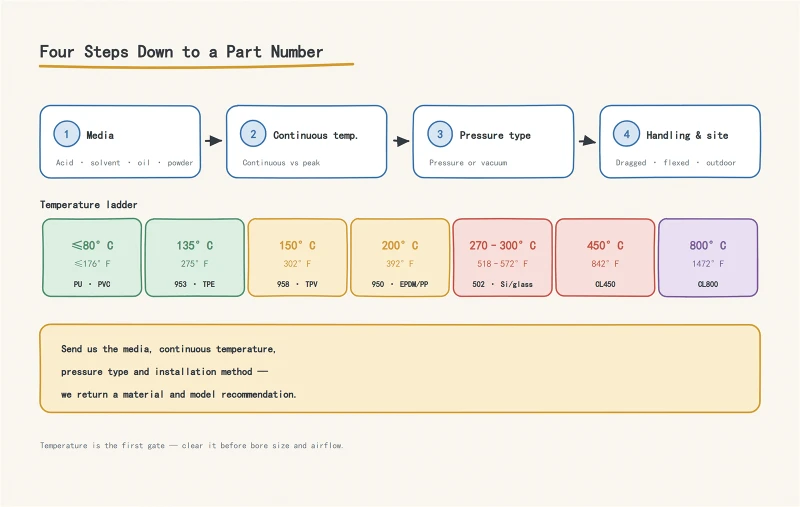
Most hose selection mistakes are not caused by picking the wrong material. They are caused by never asking the full set of questions. If you work backwards from a material list, you will happily choose a hose whose datasheet looks perfect and which fails in three months. Ask the five questions below first, and the shortlist builds itself.
What is the media? Acids and bases, organic solvents, oils, powders, granules, food, and pharmaceutical liquids each demand something different from a wall. "Acid resistant" is not one property: dilute sulfuric acid and concentrated nitric acid have almost nothing in common.
How hot, and for how long? Continuous working temperature and short-term peaks must be asked separately. Customers often say "200 degrees maximum," and a follow-up question reveals that this is thirty seconds at start-up, with 90 °C (194 °F) the rest of the day. Those two numbers point to completely different materials, so never fold them into one figure.
Pressure or vacuum? Under vacuum the wall gets pulled inward. The reinforcement carries that load, but a wall that is too soft will still collapse. The larger the bore, the lower the vacuum a hose can hold. That is physics, not a selection error.
How will the hose be handled? Left in place, dragged around, flexed repeatedly, or run over and abraded - four very different lives. Abrasion resistance and flex fatigue rarely come in the same product, and neither one comes free with heat resistance.
Will it live outdoors? Sunlight, ozone, humidity, and salt spray age some materials far faster than others. A large share of "it cracked after six months" complaints trace back to UV, not to the media.
2. Plastic Walls: A Spectrum from PVC to FEP
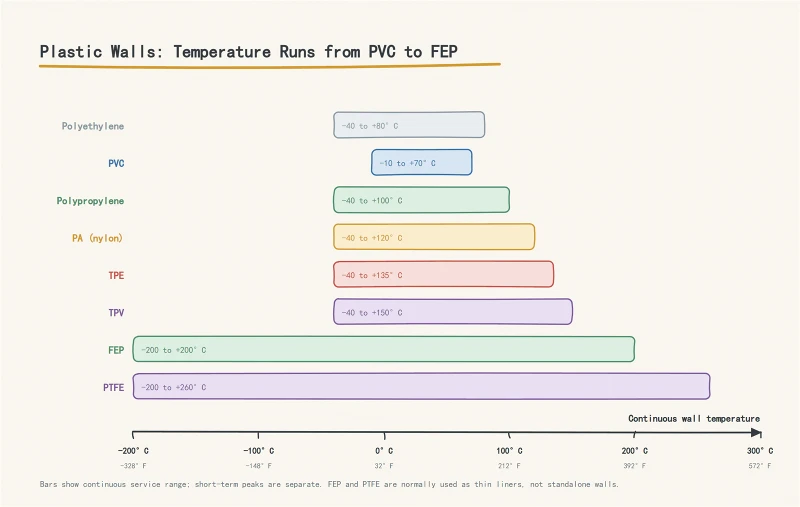
Plastic walls are inexpensive, smooth inside, and mostly available in food-grade versions. They carry the bulk of dust collection, ventilation, and powder conveying duty. Here they are, ordered by temperature.
PE - Polyethylene
Almost no weak spot against acids and bases, good at low temperature, halogen-free, and available food grade. Its limits are heat (about −40 to +60 °C / −40 to +140 °F, with HDPE reaching +80 °C / 176 °F) and weather resistance: an outdoor PE hose without carbon black embrittles within a season. Aromatic and chlorinated solvents are also out.
PVC - Polyvinyl Chloride
The widest-used grade: acid and base resistant, water resistant, flame retardant, cheap. Plasticized flexible PVC bends easily and runs about −10 to +60 °C (14 to 140 °F). Three things to watch. Plasticizer migrates, so the hose stiffens over time. Ketones, esters, and aromatics attack it. And in washdown recovery water, surfactants plus hot water will shorten its life noticeably.
PP - Polypropylene
A wider chemical range than PE and one temperature step higher (around +100 °C / 212 °F), with good resistance to stress cracking. It goes brittle in the cold though, cracking below −10 °C (14 °F), so keep it away from outdoor winter service. ZIMFLEX 501 uses a PP wall, with PVC and PE versions available on request.
PA - Polyamide (Nylon)
Abrasion resistance and oil resistance are its strengths, along with high strength and a continuous rating near +120 °C (248 °F). The trade-off is moisture absorption: dimensions change as it takes on water, so be careful in continuously wet or high-humidity duty. Against strong acids and bases it is only fair, and against bases it is poor.
TPE, TPR, and TPV
Thermoplastic elastomers: rubber-like feel, plastic-like processing. TPE offers good weather resistance and food-grade options, and can be extruded into a thin wall. TPR is softer and suits applications where hand feel matters. TPV is a dynamically vulcanized blend of EPDM and PP, stable against weather, ozone, and hydrolysis, with a ceiling around 135 to 150 °C (275 to 302 °F). The wall of ZIMFLEX 953 is TPE with a steel wire helix, rated −20 to +135 °C (−4 to 275 °F) - a common choice for 135 °C flue gas exhaust. ZIMFLEX 958 uses TPV for 150 °C (302 °F) service and holds up far better against hydrolysis than PU.
PTFE and FEP - Fluoropolymers
The far end of chemical inertness. PTFE runs continuously from −200 to +260 °C (−328 to 500 °F) and resists nearly every chemical, with molten alkali metals and elemental fluorine the notable exceptions; it is also non-stick and an excellent electrical insulator. FEP is the melt-processable version of the same chemistry, rated −200 to +200 °C (−328 to 392 °F), and clearer, so you can see the media inside. Both share the same weaknesses: modest mechanical strength, modest abrasion resistance, high cost, and poor resistance to collapse under vacuum. That is why they are normally used as a thin liner or a lined hose, not as a standalone wall.
3. Rubber Walls: NR, SBR, NBR, EPDM, Latex, Silicone
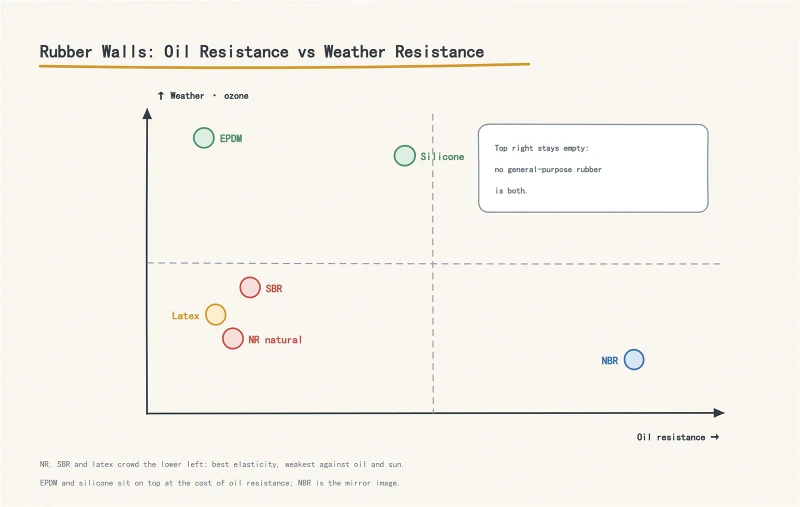
Rubber walls are elastic, fatigue resistant, and handle vacuum well, which makes them the natural choice where a hose flexes repeatedly or sucks rather than blows. The six common grades divide the work cleanly.
NR - Natural Rubber
Elasticity and rebound are where it beats everything else, with good abrasion resistance and long dynamic fatigue life - the reason it dominates anti-vibration mounts and wear linings. It dislikes oil, ozone, and prolonged sunlight, so outdoor use needs protection.
SBR - Styrene Butadiene Rubber
A synthetic stand-in for natural rubber, with better abrasion and aging resistance than NR at lower cost. Oil resistance is still poor, and outdoor service still needs a protective layer.
NBR - Nitrile Rubber
Oil and solvent resistance is its defining skill: mineral oil, hydraulic oil, and vegetable and animal oils are all manageable, making it the first choice for oily media. The reverse is weather and ozone resistance, which is poor - keep it out of sunlight or change the material.
EPDM - Ethylene Propylene Diene Rubber
Weather, ozone, water, and steam resistance make it a regular for outdoor and hot-water duty. Against oil it has almost no defence and will swell in mineral oil over time. The wall of ZIMFLEX 950 is an EPDM/PP coated polyester fabric with a rigid plastic helix, rated for continuous +200 °C (392 °F) - provided 50% fresh air is blended in. Stating that prerequisite is not optional; leaving it out makes the claim misleading.
Latex
Extremely elastic, able to run an extremely thin wall, and soft to the touch, which suits single-use tubing, medical lines, and peristaltic pumps. Heat resistance is modest (roughly −30 to +70 °C / −22 to 158 °F), and oil and solvent resistance are both poor, as is service life.
Silicone Rubber
A wide temperature span: continuous −60 to +220 °C (−76 to 428 °F), with short-term excursions to +260 °C (500 °F). It is also weather and ozone resistant, odourless, non-toxic, and available in FDA-compliant grades. The weaknesses are modest oil and solvent resistance and relatively low tear strength - do not put it on abrasive duty. ZIMFLEX ZS05, ZS09, and ZS14 are all FDA-certified silicone hoses; ZS14 adds a double layer of fabric and a single steel wire helix to lift pressure and temperature capability together.
4. Matching Five Service Conditions to Materials
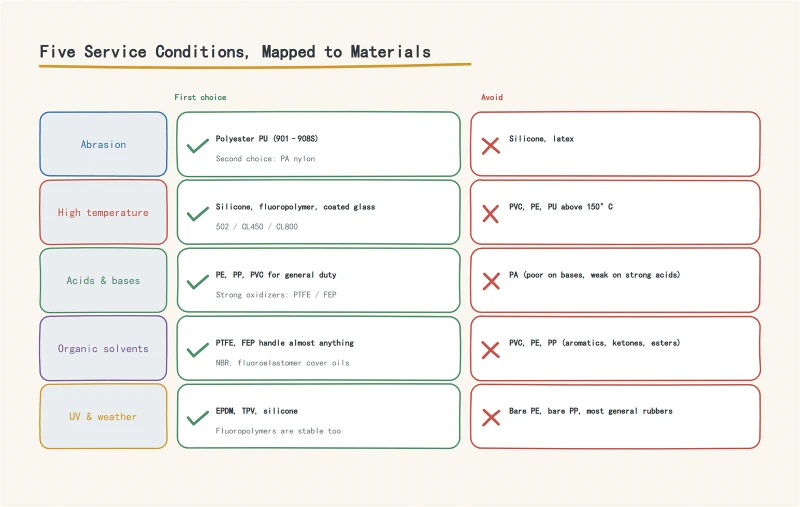
The previous sections covered the materials themselves. This one states the conclusions directly, condition by condition.
Abrasion. Polyurethane first. The ZIMFLEX 901 through 908S range uses a polyester-based PU wall over a steel wire helix, and it is the standard answer for powders, sand, grit, and wood chips moving at speed. Polyamide is the second choice. Silicone and latex should be ruled out.
High temperature. Silicone and fluoropolymers lead. In product terms it becomes a temperature ladder: up to 80 °C (176 °F), PU and PVC are sufficient; 135 °C (275 °F) is covered by TPE in the 953; 150 °C (302 °F) by TPV in the 958; 200 °C (392 °F) by the EPDM/PP coated 950, with the 50% fresh air requirement; 270 to 300 °C (518 to 572 °F) by the silicone-coated glass fabric of the 502; and above that, CL450 reaches 450 °C (842 °F) and CL800 reaches 800 °C (1472 °F). Temperature is the first gate - clear it before discussing bore size or airflow.
Acids and bases. PE, PP, and PVC generally suffice, while strong oxidizing acids call for PTFE or FEP. Watch the difference between acids and bases: PA is only fair against acids and noticeably worse against bases.
Organic solvents. PTFE and FEP handle almost everything. NBR and fluoroelastomers cover most oils and aliphatic hydrocarbons. PVC, PE, and PP have to step aside when aromatics, ketones, or esters are present.
UV resistance. EPDM, TPV, silicone, and fluoropolymers are inherently stable. PE, PP, PVC, and most general-purpose rubbers need carbon black or an outer protective layer, or they will not last outdoors.
5. The Wall Is Only Half of It - the Rest Is Construction

Once the wall material is settled, three more things decide whether the hose actually works.
The reinforcement. Under vacuum the wall provides sealing and abrasion resistance while the steel helix resists collapse. On the same hose, a larger bore holds less vacuum: on the 801, DN32 is rated 0.91 bar, DN51 drops to 0.59 bar, DN102 to 0.43 bar, and DN152 to just 0.33 bar. One more point worth stating plainly: the physical limit for vacuum in a flexible hose is about 0.1 MPa. No hose on the market is rated above it, so a requirement phrased that way is not a real requirement.
Structure and form. Where the hose must be dragged and coiled, choose a flexible wall over a steel wire helix. Where the line stays put and only the hood needs to be aimed, choose the interlocking, shape-retaining construction of the 501. In one line: if the line must move, take the 801; if the line stays still, take the 501.
The coupling. The coupling's material and sealing class must never be lower than the hose itself - a food-grade hose fitted with an ordinary coupling is a wasted selection. Where static control matters, the coupling must also preserve electrical continuity; ZIMFLEX uses the 991R bridge clamp to press the steel helix onto the flange and close that path.
6. A Quick-Reference Table
|
Service condition |
First choice wall |
Acceptable alternative |
Avoid |
|
Abrasion (powder, sand, wood chips) |
Polyester-based PU |
PA (nylon) |
Silicone, latex |
|
Continuous ≤80 °C (176 °F) |
PU, PVC |
PP, TPE |
Latex |
|
135 °C (275 °F) flue gas |
TPE (953) |
Silicone |
PVC, PE, PU |
|
150 °C (302 °F) |
TPV (958) |
Silicone |
PVC, PE, PU |
|
200 °C (392 °F), 50% fresh air |
EPDM/PP coated fabric (950) |
Silicone-coated glass fabric |
Thermoplastic walls |
|
270–300 °C (518–572 °F) |
Silicone-coated glass fabric (502) |
- |
All thermoplastics and general-purpose rubbers |
|
450 °C / 800 °C (842 / 1472 °F) |
Glass fibre with silicone coating (CL450) / speciality glass fibre (CL800) |
- |
See above |
|
Acid resistance |
PE, PP, PVC |
PTFE, FEP (strong oxidizing acids) |
PA (strong acids) |
|
Base resistance |
PE, PP |
PTFE, FEP |
PA |
|
Organic solvents |
PTFE, FEP |
NBR, fluoroelastomer |
PVC, PE, PP (aromatics / ketones / esters) |
|
Outdoor UV |
EPDM, TPV, silicone |
Carbon-black stabilized PE / PP |
Bare PE, bare PP, most general-purpose rubbers |
The table is a starting point, not an answer. The real difficulty is that service conditions stack: oil resistance plus outdoor exposure, or abrasion resistance plus repeated flexing. No single material covers everything at once. Rank the requirements, lock in the one you cannot compromise on, and solve the rest through construction, coatings, or by splitting the run into two different hoses.


